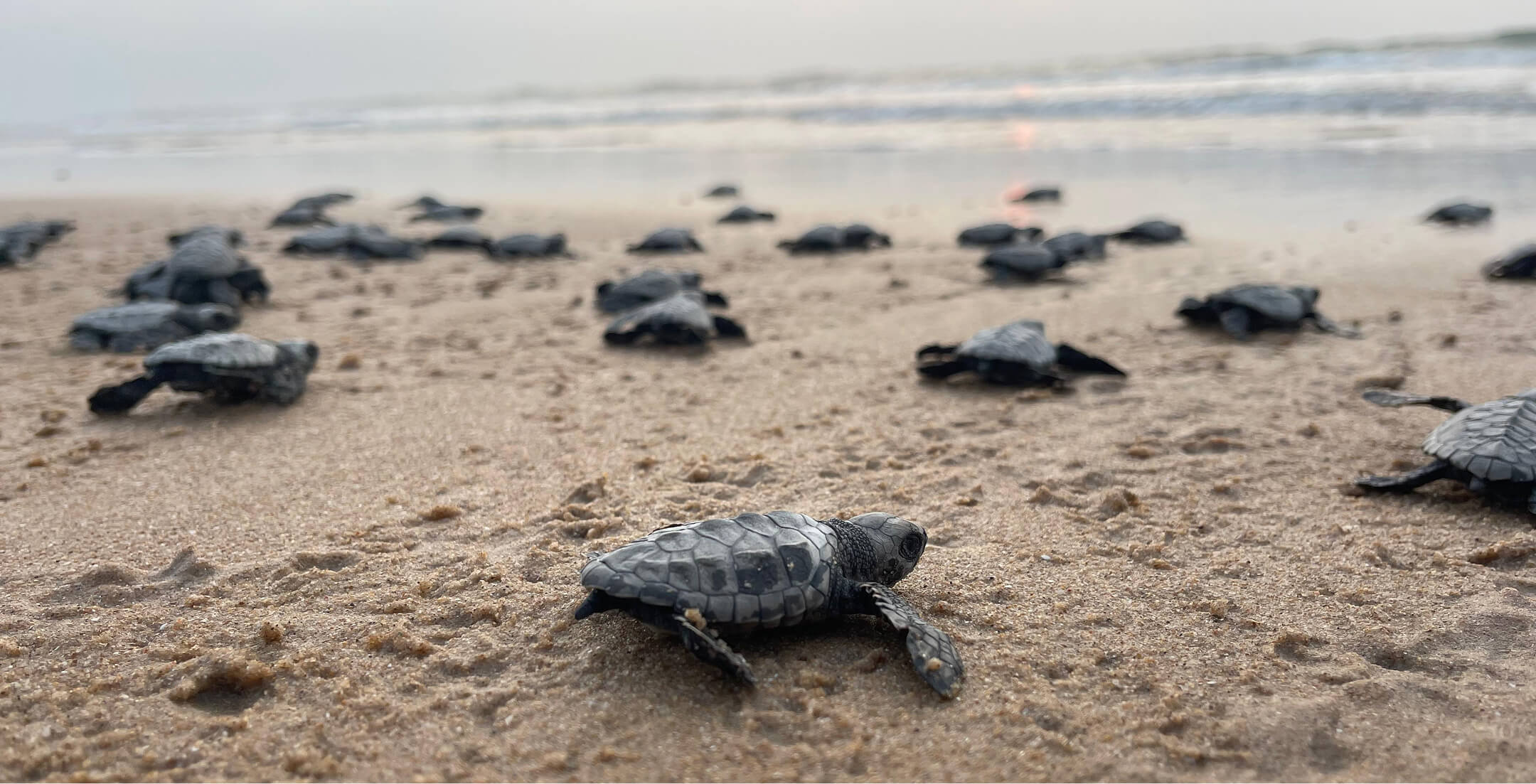
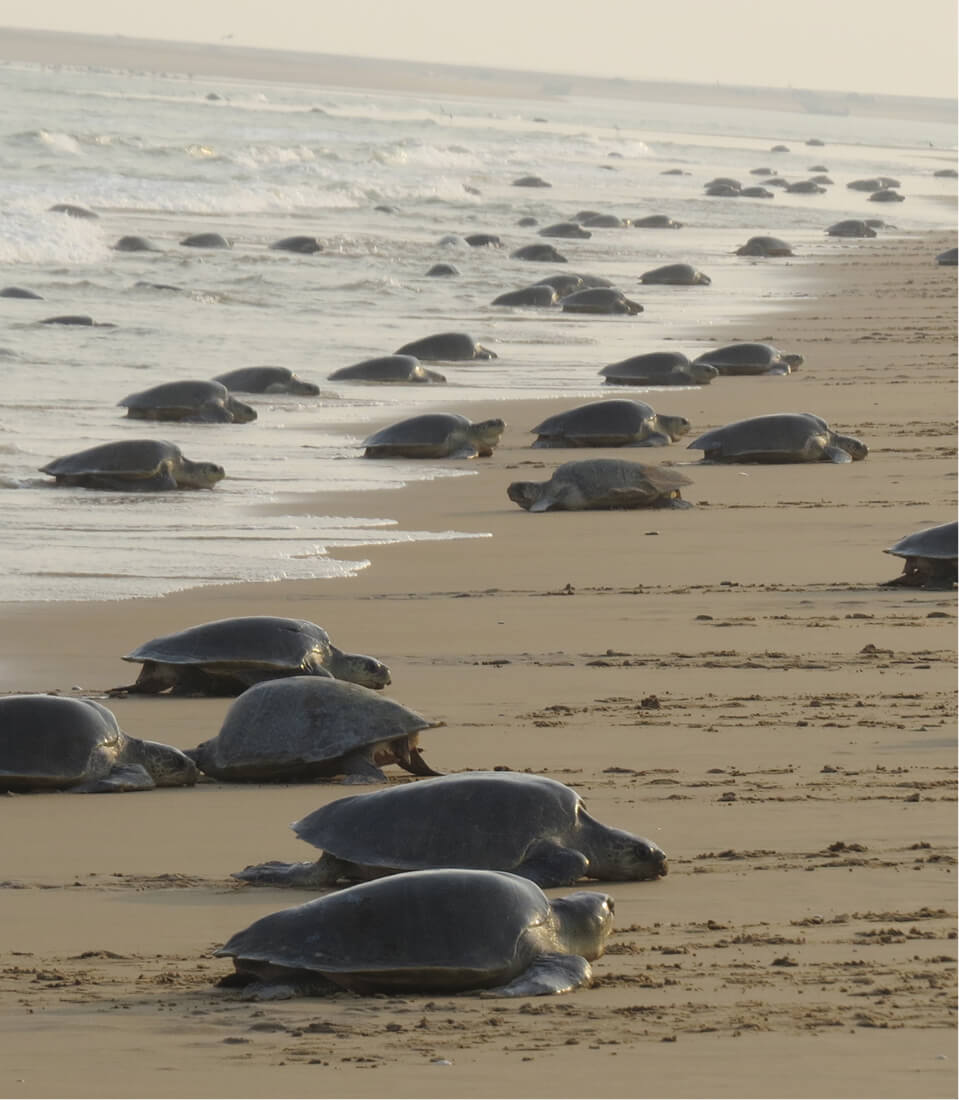
The olive ridley sea turtle is the smallest sea turtle species, known for its olive green carapace (shell). They are well known for their mass nesting behaviour also called the arribada, where tens of thousands of females nest simultaneously. Olive ridleys are the most abundant turtle species, but are listed by the IUCN as Vulnerable due to threats such as egg harvesting, accidental capture in fisheries, and habitat loss.
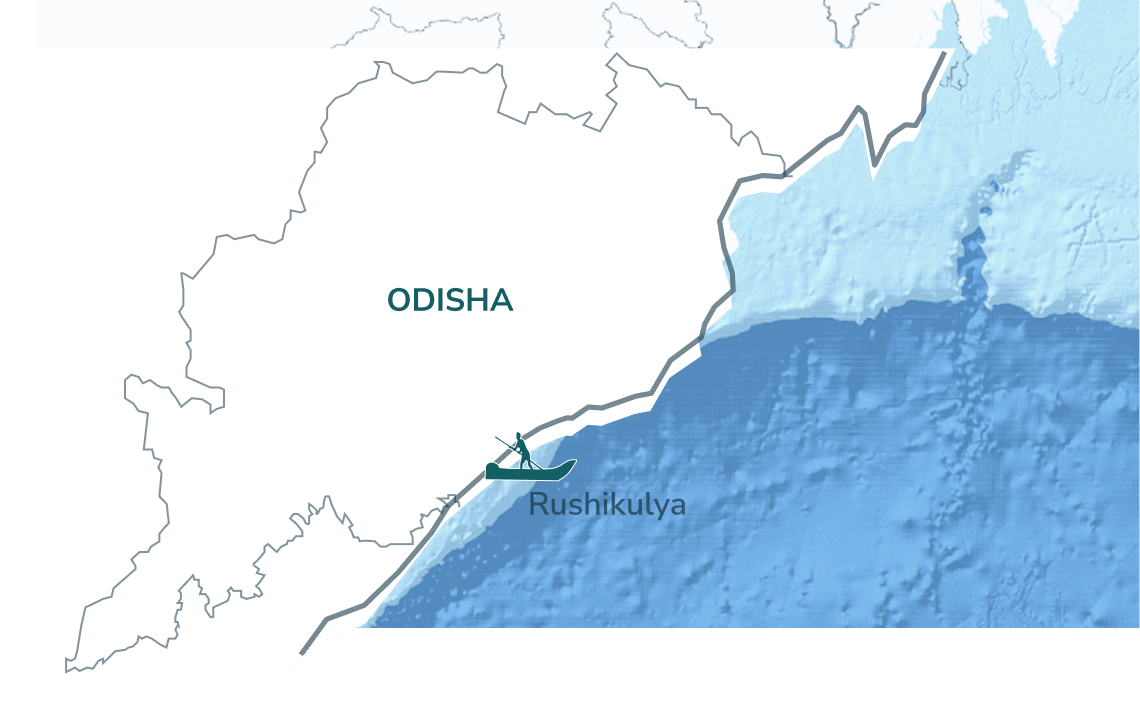
In India, Rushikula and Gahirmatha in Odisha host one of the largest nesting populations, about 3,00,000 females nesting each year. However, rapid coastal development threatens this critical nesting site, and other ridley habitats in the region are also increasingly at risk.
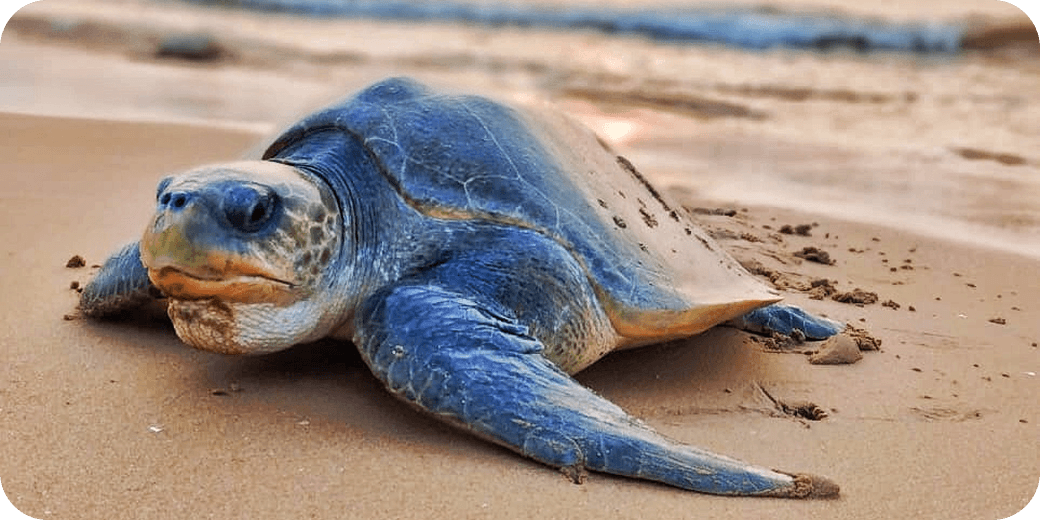
Olive Ridley Sea Turtle
- Scientific name: Lepidochelys olivacea
- Habitats: offshore waters, nearshore areas, sandy beaches
- Known for: mass nesting (arribada)
- key nesting sites: Odisha coast (Rushikulya)
- Project initiated: 2008
Project overview
Since 2008, Dakshin Foundation has worked in collaboration with the Centre for Ecological Sciences at the Indian Institute of Science, Bangalore, and the State Forest Department to monitor olive ridley populations at Rushikulya and Gahirmatha. These two sites are the only major mass nesting beaches for olive ridleys outside Central America, making Odisha globally significant for the species.
Our work primarily focuses on Rushikulya, where we monitor nearshore and nesting populations. This includes monitoring the offshore population during the breeding season to determine spatial and temporal variation in abundance and distribution, assessing population trends, and measuring hatching success to determine reproductive output.
The impact of climate change on the sex ratios of hatchlings is also assessed. As the hatchlings that emerge from mass nesting events likely influence most of the recruitment into the population, skewed sex ratios from these events could impact the long-term survival of the population.
What we do
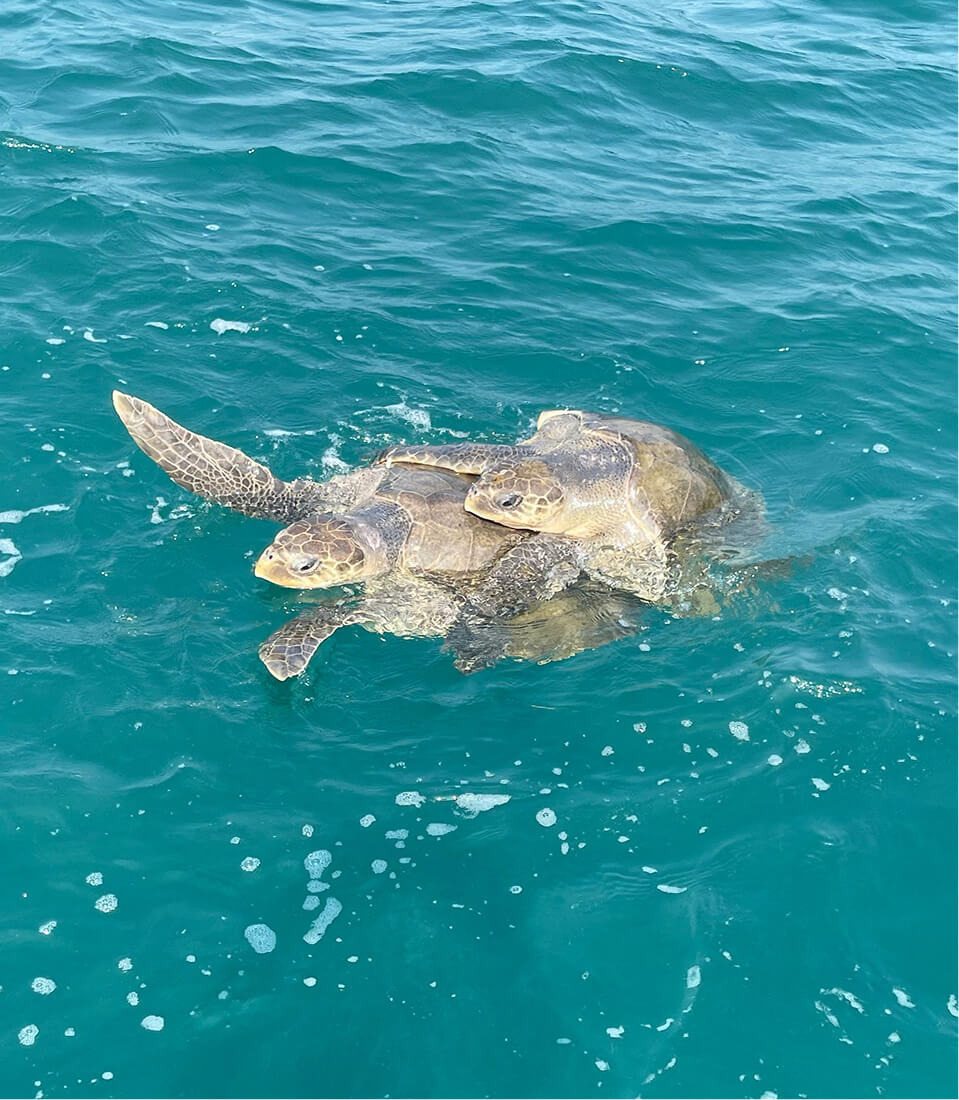
Long-term monitoring of offshore populations
Offshore olive ridley turtle populations are monitored during the breeding season. The aim is to understand spatial and temporal variation in the density and distribution of turtle aggregations.
Since 2010, we have initiated offshore aggregation monitoring using a line transect-based approach. These in-water surveys provide information on the location and movement of turtle aggregations and offer an additional metric for assessing long-term population trends beyond nesting data. This spatial understanding is essential to help inform discussions around fishing practices and management measures aimed at reducing fisheries conflict.
Nesting beach monitoring and population trends
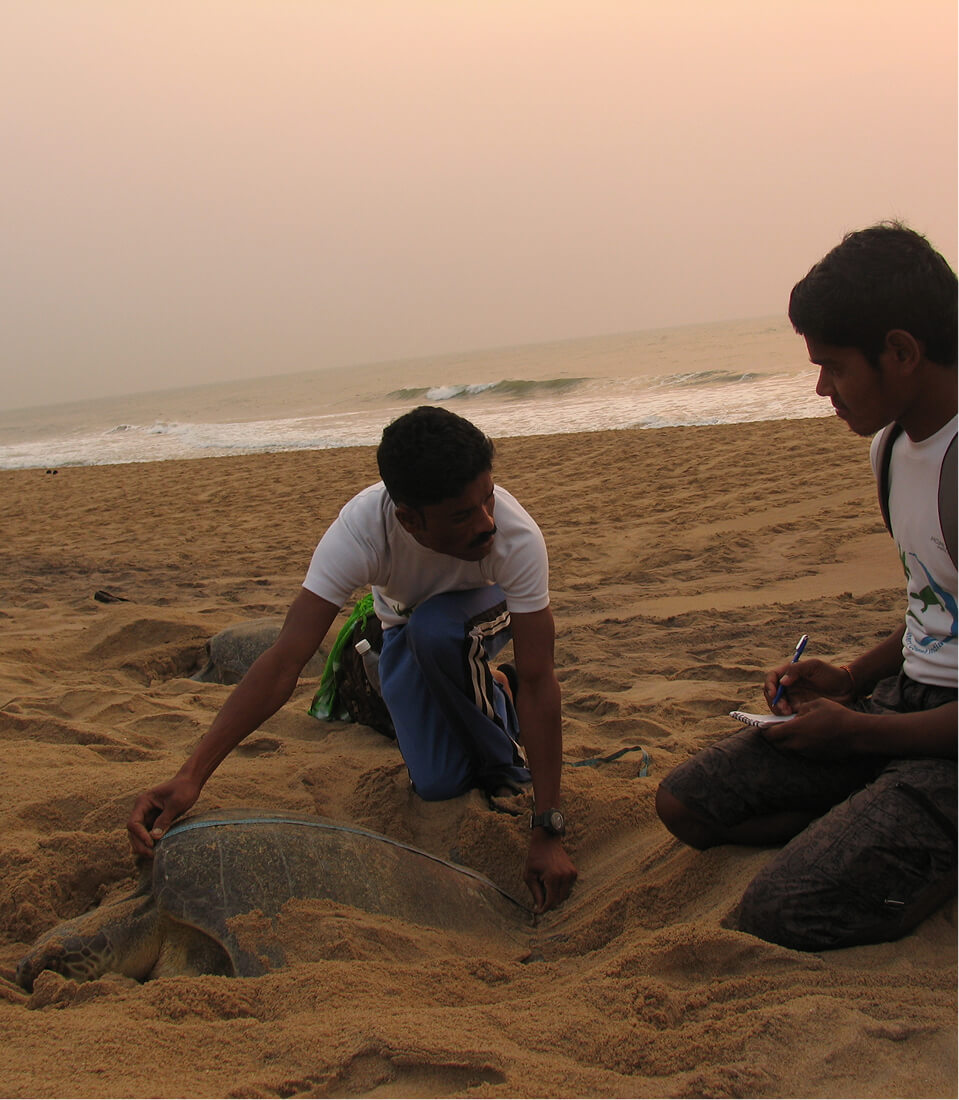
Daily night patrols are conducted along the 4 km long nesting beach at Rushikulya to estimate solitary nesting intensity throughout the season. In addition, mass nesting, or arribada, censuses are carried out using a standardised procedure to assess nesting population trends.
These surveys form the backbone of long-term monitoring at the site and allow for consistent comparison across years.
Reproductive output and hatchling success
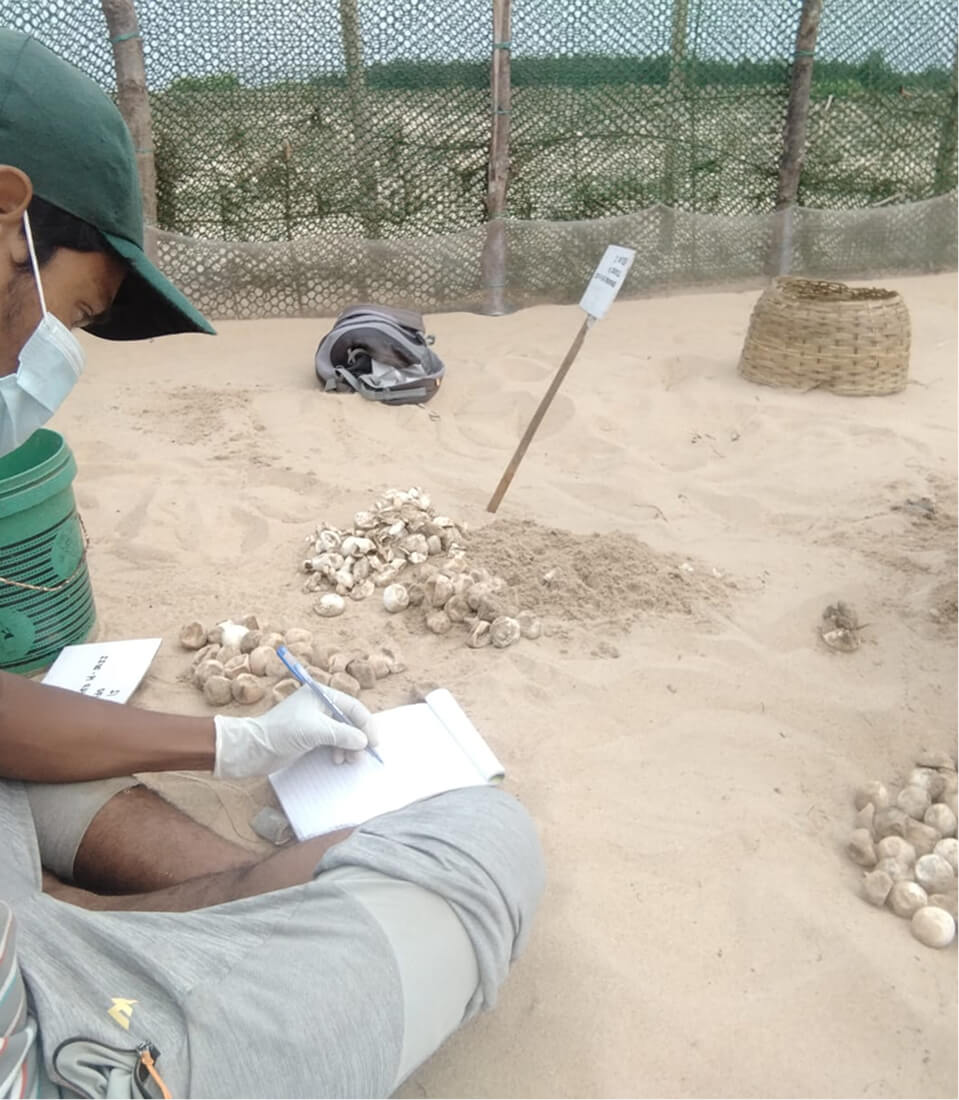
Clutch size, hatching success, and emergence success are measured to estimate annual reproductive output. These measurements allow variation in reproductive performance to be assessed across seasons and years, and help identify factors influencing nesting success.
Climate influences on reproduction
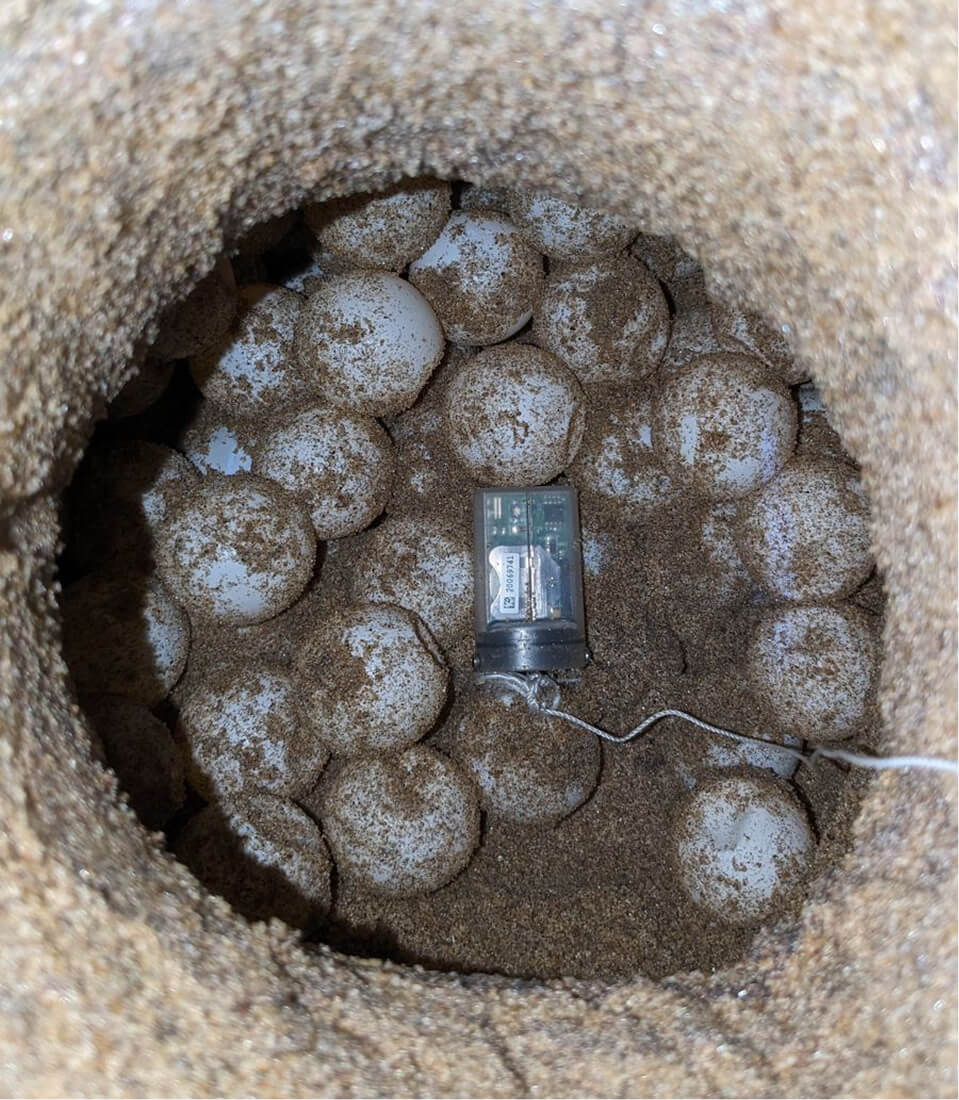
The project also examines the potential impacts of changing temperatures on hatchling sex ratios. We record nesting temperatures at the beach and determine primary sex ratios through gonad histology of dead hatchlings.
This work contributes to understanding how temperature-driven processes may influence sea turtle populations under changing climatic conditions.
Nesting habitat dynamics and shoreline change
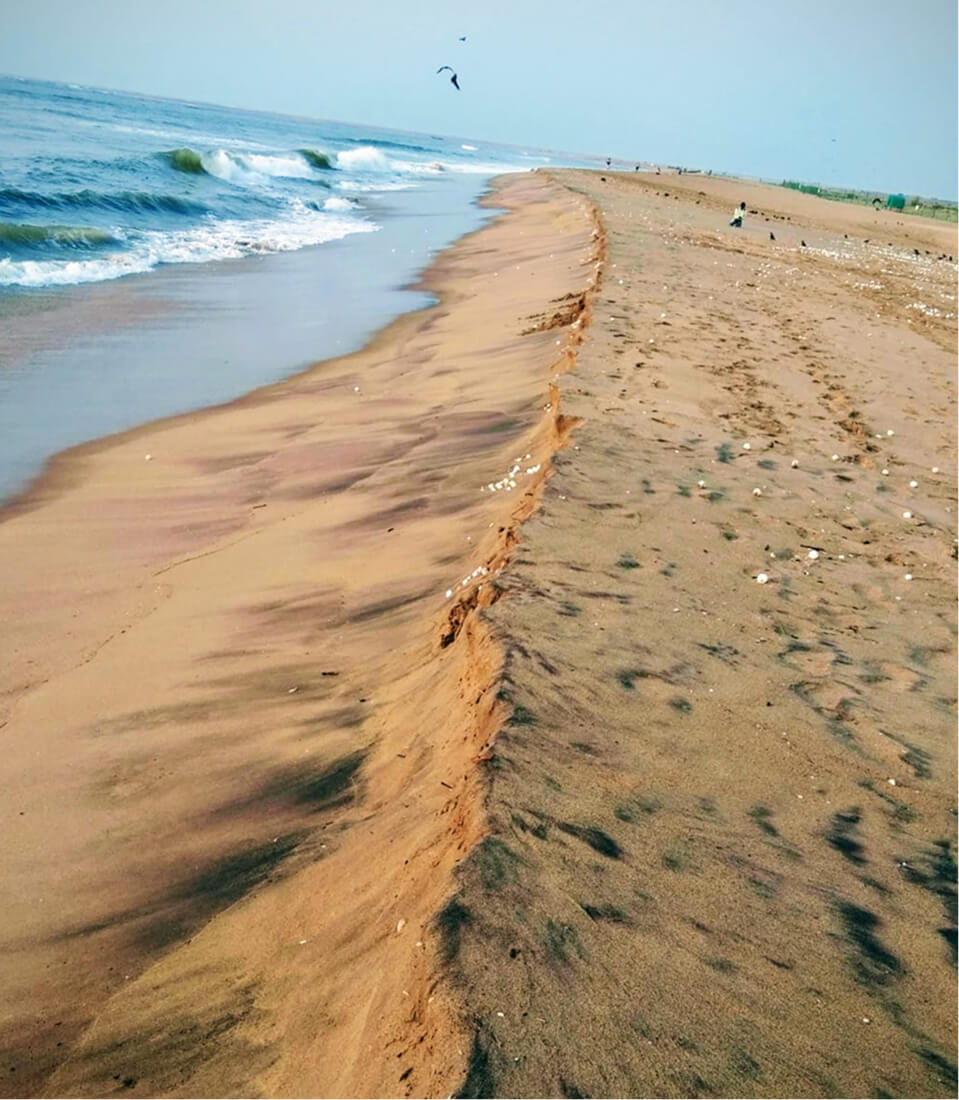
The nesting beach at Rushikulya is highly dynamic, with changes in shape and form occurring annually. We monitor variations in beach slope and width throughout the nesting season to understand how these changes influence nesting intensity and reproductive success.
In addition, beach mapping is conducted to document shoreline changes within and across years, helping link habitat dynamics to nesting patterns.
Capacity building and collaboration
Alongside research, we work closely with the local forest department to conduct training and capacity-building workshops for frontline staff. These focus on arribada census techniques, data management, hatchery maintenance and best practices and hatchling release techniques.
We also collaborate with local sea turtle conservation organisations to conduct training workshops and outreach programmes, strengthening local capacity for long-term monitoring and conservation.

Project timeline
2023
Building dynamic, up-to-date knowledge on India’s blue carbon ecosystems to support responsible climate action.
2024
Supporting the design of livelihood and income-generation models that are ecologically sound, locally relevant.
2025
Advancing approaches to blue growth that centre equity, sustainability.
2023
Building dynamic, up-to-date knowledge on India’s blue carbon ecosystems to support responsible climate action.
Resources
With coral reefs at risk, new ‘Changing Planet’ explores innovative solutions

24 Oct,2023
3 min read
Get inspired by this revived W.H. Auden’s Hymn to the United Nations. "Let music for peace Be the paradigm, For peace means to change At the right time, As the World-Clock, Goes Tick and Tock.So may the story Of our human city Presently move
Read moreOne-fifth of Mekong River fish face extinction
24 Oct,2023
3 min read
International days and weeks are occasions to educate the public on issues of concern, to
Read moreBiologist’s keen eye spots (another) new species in the Pacific
24 Oct,2023
3 min read
In 1945, representatives of 50 countries met in San Francisco at the United Nations Conference on International Organization to draw up the United Nations Charter. The United Nations officially came into existence on 24 October 1945
Read moreMeet the team

Aarthi Sridhar
Programme Head
Aarthi Sridhar
Programme Head
Aarthi Sridhar
Programme Head
Aarthi Sridhar
Programme Head
Aarthi Sridhar
Programme Head
Partner institutions